&geometry(167x91) "Ure's Country Kitchen")

The Ultimate Mini-Golf Guide: How to Perfect Your Putting Technique
Make The Most Out of Your Next Mini-Golf Experience!
Let’s be entirely honest and realistic with each other for a moment: while miniature golf is explicitly designed to be a lighthearted, deeply nostalgic, family-oriented game packed with shared laughter and casual weekend fun, absolutely nobody actually enjoys watching their neon-colored golf ball bounce hopelessly into a rocky water hazard three consecutive times.
There's an incredible, quiet, and undeniable thrill that comes with stepping up to a complex tee box, scanning the terrain, lining up a highly technical shot, giving it a stroke of supreme confidence, and watching it elegantly navigate a treacherous maze of rocks and slopes to drop cleanly into the cup for a spectacular hole-in-one.
Whether you're looking to secure ultimate, long-lasting bragging rights over your highly competitive children, lead your corporate team to a resounding victory during a local company outing, or simply avoid the social embarrassment of hitting the dreaded "maximum stroke count" on a particularly challenging hole, having a solid, mechanical grasp of basic mini-golf putting technique can completely transform your entire gameplay experience.
The great news is that you absolutely don't need to be a naturally gifted, hyper-athletic professional to master the pristine greens at Ure’s Country Kitchen in Amherstburg. You don't need to invest in expensive custom gear, and you certainly don't need to dedicate hours of tedious daily practice to see dramatic improvements in your scorecard.
Miniature golf isn’t a game of brute physical strength or raw athletic power; it is a beautiful, deeply satisfying game of real-world applied geometry, basic physics, environmental observation, and mental patience.
To help you decisively dominate the local leaderboard on your very next family day out, we’ve put together the absolute ultimate, comprehensive guide to perfecting your putt. Here are the professional insider secrets, physical mechanics, and tactical strategies that will have you putting like an absolute legend on the greens.
1. Mastering the Setup: Stance, Balance, and Grip
A truly great putt does not begin when your club strikes the ball; it actually starts long before your putter face ever makes contact with the turf. Just like in traditional, full-scale championship golf, your physical posture, your bodily balance, and the manner in which you manually hold the club lay the foundational, unyielding groundwork for directional accuracy and distance control. If your physical setup is flawed, your shot will be inherently inconsistent, regardless of how well you try to adjust mid-swing.
The Foundation of Supreme Control
To achieve a rock-solid foundation before you swing, pay close attention to these three core physical components:
The Grip
Forget the intense, high-pressure grip you might naturally use when swinging a baseball bat, holding a tennis racket, or gripping a hockey stick. In miniature golf, tension is the absolute ultimate enemy of precision. You want to hold the mini-golf putter with light, incredibly relaxed pressure.
A tight, white-knuckled grip instantly tenses your forearms, locks up your wrists, destroys your natural depth perception, and inevitably causes jerky, unpredictable swing movements. Hold the club firmly enough to maintain absolute control over the angle of the face, but loosely enough that you can easily feel the natural weight of the putter head swaying at the bottom of the shaft.
The Stance and Balance
Position your feet precisely shoulder-width apart, ensuring they are completely parallel to your intended target line. Avoid leaning too far forward onto your toes or tilting backward onto your heels; your body weight should feel perfectly centered, balanced, and anchored securely to the ground. Bend slightly at the hips, allowing your arms to hang down naturally and smoothly below your shoulders. This balanced posture creates a stable, immovable platform that prevents your torso from swaying or tilting during the execution of the shot.
When your posture is truly locked in, you eliminate the unnecessary body movements that cause your putter face to twist offline. A steady stance acts as a chassis for your swing, anchoring your lower half so your upper body can move independently. Keeping your knees softly flexed ensures you can absorb minor shifts in balance without disrupting your sightline. As you look down at the ball from this position, your eyes should rest directly over the target line, giving you a clear view of your path. Maintaining this structural alignment through your follow-through guarantees maximum accuracy, allowing the club to deliver a crisp, predictable strike every single time you play.
The Ball Position
Stand relative to the ball so that it is positioned directly in the center of your physical stance, or shifted just slightly forward toward your front foot. This specific alignment ensures that your putter face strikes the golf ball at the absolute flat, vertical peak of your swing arc. Striking the ball at this precise moment results in a smooth, immediate forward roll, completely eliminating the unwanted skidding, spinning, or bouncing that often occurs when a ball is struck too early or too late in the swing.
2. The Mechanics of the Pendulum Stroke
The absolute most common and destructive mechanical mistake we observe daily on our 18-hole course at Ure’s is what professional golfers refer to as a "wristy" swing. Many amateur players have a natural tendency to flick or snap their wrists at the ball at the moment of impact, essentially treating the putter like a tiny croquet mallet or a hockey stick. This uncontrolled wrist flick introduces far too many moving variables into the swing, making it incredibly difficult to accurately regulate either the direction or the power of your shot.
Incorrect (Wristy Swing): [Wrist Flick] ---> [Jerky Motion] ---> [Inconsistent Direction]
Correct (Pendulum Stroke): [Rocking Shoulders] ---> [Smooth Arc] ---> [Perfect Distance Control]
Rock Your Shoulders, Not Your Wrists
To achieve a flawless, professional-grade mini-golf putting technique, you must train your upper body to move like a mechanical clock’s pendulum. Keep your wrists completely straight, locked, and quiet throughout the entire duration of the stroke. The entirety of the motion should originate from the smooth, synchronized rocking of your shoulders.
To visualize this effectively, think of your two shoulders, your arms, and the grip of the putter as forming a solid, unbroken triangle. This triangle should sway backward and forward as one unified, rigid piece.
Furthermore, you must ensure that your backswing and your follow-through are completely equal in physical length. If you pull the putter back six inches for your backswing, make sure you accelerate smoothly and follow through precisely six inches past the ball after impact. This equal, balanced movement ensures a pure, consistent roll and prevents the ball from jumping, skipping, or skidding erratically across the synthetic turf carpet.

3. The Art of the Bank Shot: Real-Life Applied Geometry
Every single world-class miniature golf course—including our beautifully landscaped, award-winning layout here in Amherstburg—incorporates solid brick, treated wood, poured concrete, or natural stone border walls. Far too many players view these borders merely as protective barriers designed to keep the golf balls from rolling away into the surrounding flower beds. This is a massive strategic mistake! In reality, these borders are your absolute best secret allies on the course, designed to help you bypass impossible angles.
The Law of Reflection
When a hole is designed such that you cannot take a direct, straight physical line from the tee box to the cup due to an intentionally placed obstacle—such as a water fountain, a rock pillar, or a sharp dog-leg corner—you must master the fine art of the bank shot. Fortunately, mini-golf follows the rigid, absolute laws of classical geometry, specifically the Law of Reflection: the angle of incidence always equals the angle of reflection.
Angle of Incidence=Angle of Reflection
In simple, practical terms: the exact mathematical angle at which your golf ball strikes a flat border wall is the exact same angle at which it will bounce off that wall on the other side.
To execute a flawless bank shot, utilize these pro-level visualization strategies:
Locate the Apex Point: Do not look directly at the hole or directly at your ball. Instead, visualize an imaginary, straight line extending from your ball to the border wall, and a matching line extending from the wall straight to the cup. Aim your putter directly at the exact middle point where those two imaginary lines intersect on the border.
Account for Friction and Energy Loss: It is vital to remember that bank shots inherently require slightly more speed and power than a standard straight putt. The exact millisecond your golf ball collides with a solid brick or stone border wall, it will inevitably lose a small percentage of its kinetic energy and forward momentum due to the physical friction of the impact. If you hit the ball too softly, it will die right off the wall; give it a little extra crispness to ensure it has enough speed to complete its journey all the way to the pin.
4. Reading the Green: Slopes, Breaks, and Turf
In high-quality miniature golf courses, not all putting surfaces are perfectly flat, level, or uniform. To consistently score low and keep your scorecard full of twos and threes, you must learn how to actively observe, read, and analyze the physical environment surrounding the hole. You cannot simply step up and hit the ball blindly; you must treat the green like a shifting landscape.
How to Scan a Hole Like a Pro
Before you ever drop your ball onto the starting rubber tee mat, take a quick, intentional 10-to-15-second walk around the entirety of the hole to analyze its unique layout. Look for these subtle environmental factors:
Identify the Slopes and Breaks
Does the turf tilt or lean to the left or the right as it gets closer to the cup? If the ground slopes downward toward the right side of a water feature, you cannot aim directly at the hole. If you do, gravity will pull your ball off course. Instead, you must intentionally aim slightly to the left of the cup, playing the "break" and allowing the natural pull of gravity to gently curve your ball back toward the center target as it slows down.
Watch the Players Ahead of You
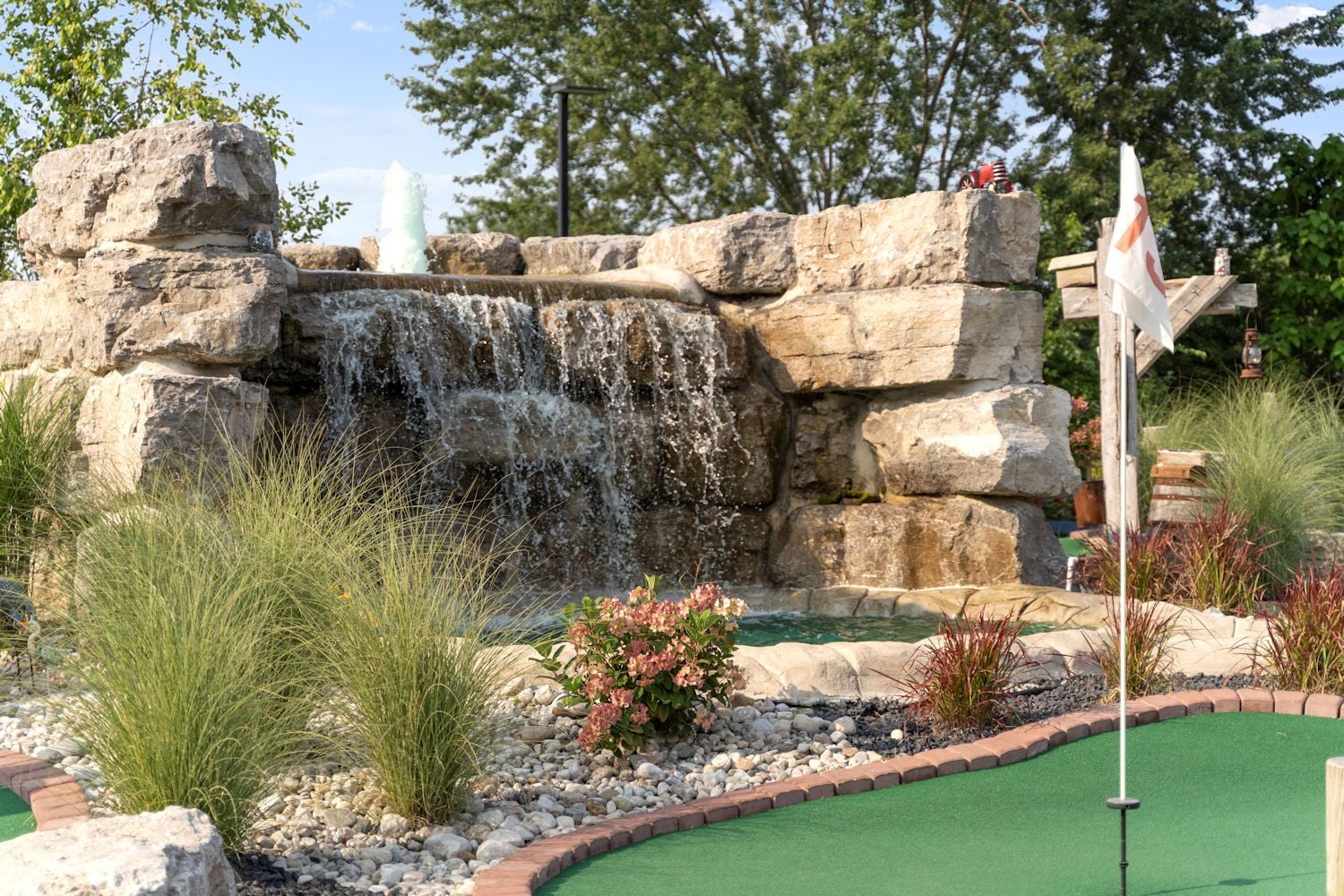
One of the absolute greatest strategic advantages in a casual round of mini-golf is playing second, third, or fourth in your family or corporate group! Never look away when your friends or family members are putting. Pay incredibly close attention to how their golf balls behave on the turf. Did Mom's ball slow down dramatically and die earlier than expected near the waterfall? Did Dad’s ball take a sudden, sharp, unexpected turn near a particular rock border?
Learn from their mistakes and their successes, and adjust your own shot power and alignment based on the real-time data they just provided for you.
Clear Natural Debris
Because Ure's 18-hole course is deeply embedded in a gorgeous, lush outdoor environment surrounded by trees, gardens, and flowers, a stray autumn leaf, a small twig, or a stray pebble can occasionally find its way onto the green fairways. Never attempt to putt straight through an obstacle like that! It will instantly deflect your ball off course. Feel free to gently brush away any natural debris from your intended putting path before taking your final stance.
5. Managing Your Mindset: The Psychology of the Short Game
While mastering the physical pendulum stroke and understanding the geometry of bank shots are vital pieces of the puzzle, a massive portion of mini-golf mastery takes place entirely between your ears. The short game is an intense test of psychological focus, emotional control, and patience. It is incredibly easy for a player to lose their concentration after one unlucky bounce and let their entire scorecard spiral out of control.
When your ball takes an erratic hop off a stone edge or rolls backward down a hill, your brain registers immediate frustration. If you let that annoyance dictate your next stroke, you will likely hit the ball too hard, rush your setup, and compound the initial mistake. True masters understand that mental discipline is just as important as physical technique on the greens. You must treat every hole as an isolated event, leaving past errors behind you. By taking a slow breath, resetting your posture, and visualizing a clean path to the cup, you regain the focus necessary to execute a flawless recovery shot. Staying cool under pressure turns potential disasters into triumphant moments of playground redemption.
Stay Present and Patient
If you closely watch professional golfers competing on television, you will quickly notice that they maintain the exact same calm, entirely focused demeanor whether they just sunk a spectacular fifty-foot putt or tragically missed a simple two-footer. In miniature golf, you must learn to cultivate that exact same steady, unshakeable mental mindset. Because of the naturally whimsical and erratic design of mini-putt courses, bad bounces are bound to happen. If your golf ball takes a bizarre hop off a stone border or gets caught in a steep slope and rolls all the way back to your feet, take a deep breath.
Do not rush your next shot out of frustration or anger, as this is precisely when high scores happen. Instead, step completely away from the ball, reset your physical stance, re-engage your pendulum triangle, and focus your mind entirely on the immediate shot at hand. Miniature golf is as much a test of psychological resilience as it is of physical skill. Letting a single bad stroke ruin your confidence will only sabotage your game for the remaining holes on the scorecard.
Remember, a single brilliant hole-in-one on the very next hole can instantly erase a bad score from the hole before! Every new tee box represents a completely fresh start and a brand-new opportunity to showcase your putting technique. By staying patient, laughing off the unpredictable bounces, and keeping your emotions under control, you will not only see a dramatic improvement in your final score, but you will also ensure that you have a fantastic, stress-free afternoon with your family on the greens. Morale and focus are your greatest assets, so keep your head up and keep rolling.

Put Your Skills to the Test at Ure’s Country Kitchen
Now that you possess the comprehensive, theoretical knowledge, mechanical insights, and strategic geometric secrets of a true mini-golf master, it is officially time to get some real-world mud on your tires! Reading about putting mechanics and studying angles is a fantastic starting point, but genuine muscle memory, depth perception, and course confidence can only be built by physically getting out onto the greens.
Gather your family crew, round up your corporate colleagues, load up the car, and take the beautiful, scenic drive down to Ure's Country Kitchen in historic Amherstburg. You can perfectly kick start your training day by enjoying a fantastic, fresh, and home-cooked lunch inside our dining room to fuel your mental concentration.
Once your energy is topped up, grab your favorite color golf ball, sharpen your scorecard pencil, and head out onto our beautiful course to see if you can completely conquer our turning gristmill, winding streams, and rolling slopes using your brand-new, flawless pendulum stroke. And always remember—regardless of whether you win the tournament or lose the leaderboard, everyone celebrates together with a giant, delicious scoop of premium ice cream at our dairy bar finish line!